Marsha P. Johnson
The revolution started with the people who had nothing left to lose

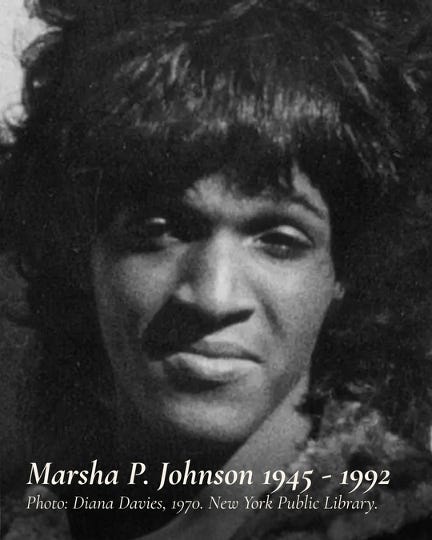
Pay It No Mind
Marsha P. Johnson was born Malcolm Michaels Jr. on August 24, 1945, in Elizabeth, New Jersey. She came of age in a country where being gay was classified as a mental disorder, same-sex intimacy was criminalized in most states, and gender nonconformity was legally punishable. The world she was born into had built its institutions specifically to exclude people like her.
As a teenager, she moved to New York City with almost nothing and found her way to Greenwich Village. She gave herself a name: Marsha, from a diner she liked; Johnson, from Howard Johnson’s restaurant; and the P., which she said stood for “Pay it no mind,” her characteristic answer whenever anyone questioned her gender.
She became a fixture of the Village, known for the enormous flower crowns she made herself, for her generosity toward people with nothing, and for refusing to diminish herself for anyone’s comfort.
Marsha’s radicalism was the natural result of being told she had no right to exist. She refused to accept it.
The Architecture of Criminalization
Between 1960 and 1967, the NYPD arrested over 100 people each week for alleged homosexual behavior. Masquerade laws made it illegal to appear in public wearing clothing “not belonging to one’s sex.” Bars serving LGBTQ patrons were raided regularly, and the names of those arrested were published in newspapers, destroying careers and families through exposure alone.
This was not incidental policing. It was a systematic campaign to render LGBTQ life invisible. Marsha was arrested under this pretense dozens of times over the course of her life. She had harmed no one, but the system had defined her existence as inherently harmful to justify its bias.
For Black queer and transgender people, the violence was multiplicative. American policing was organized around the protection of White, middle-class, heterosexual norms. A person who was Black, queer, and poor occupied the most exposed position within the system.
Marsha occupied that position.
Stonewall
In the early hours of June 28, 1969, plainclothes police officers arrived at the Stonewall Inn and announced a raid. Patrons were expected to cooperate. That night, they did not.
Drag queens, transgender women, gay men, and young people with nowhere else to go began to resist. A crowd gathered on Christopher Street and grew rapidly. By the time officers had retreated into the bar and barricaded the door, the crowd numbered in the hundreds. The uprising continued through the night and resumed over the following days.
Marsha P. Johnson was there. Accounts consistently place her among those who responded first and most fiercely. What is not in dispute is this: the people who fought back first were the people who had the least to lose, because the system had already taken almost everything from them.
The Stonewall Uprising was not a spontaneous explosion. It was the result of decades of institutional violence colliding with a community that refused to take any more.
Building What the Movement Abandoned
In 1970, Marsha and Sylvia Rivera co-founded STAR: Street Transvestite Action Revolutionaries. They rented a building in Lower Manhattan, funding it through their own sex work, and opened it to homeless transgender youth who had nowhere else to go.
Mainstream gay organizations declined to associate with them. The political calculus was explicit: STAR’s founders were considered a liability to respectability politics. The people they served were the people the movement had decided it could not afford to champion.
STAR created community care from nothing, sustained by the same survival strategies the movement had deemed too scandalous to acknowledge.

Erased by the Movement She Built
As the LGBTQ rights movement gained institutional power through the 1970s, a deliberate narrowing occurred. The organizations gaining influence were increasingly dominated by White, cisgender, middle-class gay men focused on demonstrating that gay people were unthreatening to mainstream norms.
In 1973, Sylvia Rivera was physically removed from the stage at the Christopher Street Liberation Day rally by gay men who regarded her advocacy as politically damaging. She was booed by much of the crowd. A transgender woman of color who had been among the first to fight back at Stonewall was silenced at the anniversary of the uprising she helped start.
Marsha faced the same erasure. She remained beloved in the Village, yet absent from political organizations, legislative campaigns, and mainstream media. Her contributions were not disputed. They were simply omitted.
Recognition offered after someone’s death is not justice. It is the bare minimum owed by a movement built on someone’s contributions while refusing to acknowledge them.
The AIDS Crisis
The 1980s brought catastrophe. By 1992, more than 160,000 Americans had died of AIDS-related causes. The Reagan administration did not publicly acknowledge the epidemic until 1987, after more than 20,000 had died.
Marsha lost most of her closest friends. The community she had built over two decades was hollowed out by grief at a pace that left no time to recover between losses. She joined ACT UP, marching and demanding that the government respond with something other than indifference.
She showed up for people who had nowhere else to turn. Something she had always done.
The System That Pathologized Her
Marsha experienced serious mental health challenges and was hospitalized on multiple occasions. The institution that was supposed to care for her was invested in defining her as disordered.
During her lifetime, psychiatric hospitalization for queer and transgender people frequently involved forced attempts to modify gender expression through behavioral interventions, involuntary medication, and isolation from affirming communities. These were not the practices of individual bad actors. They were the standard of care.
Whatever care she received was provided by a system that treated her gender identity as the problem requiring treatment—not poverty, not police violence, not housing instability, not the grief of repeated loss. The system looked in the wrong direction.
The institutions that were supposed to help Marsha P. Johnson failed her. Care that pathologizes someone’s identity ignores the real issue.
A Death Without Justice
On July 6, 1992, Marsha P. Johnson’s body was found floating in the Hudson River. She was 46. Twelve days before, she had marched in the Pride parade marking the 25th anniversary of Stonewall. Those who saw her described her as joyful and energized.
The NYPD ruled her death a suicide within days, before a toxicology report was completed. Witness accounts describing men following her in the days before her death were not investigated. Reports that she had expressed fear for her safety were set aside.
In 2012, the case was reclassified as “undetermined.” No one has ever been identified, charged, or held accountable.
A police department that had arrested her dozens of times for the crime of her identity did not suddenly become capable of treating her death as a tragedy worthy of justice.
The Patterns Persist
More than 500 anti-LGBTQ bills were introduced in state legislatures in 2023 alone. The criminalization Marsha faced under masquerade laws has not disappeared. It has been repackaged as bathroom bills, sports bans, and healthcare restrictions.
The masquerade laws that targeted Marsha P. Johnson have been rebranded, but the logic is the same: some people require legal management rather than equal protection.
Your Existence Matters
If you are wondering whether it is worth being exactly who you are in a world that has treated your identity as a problem to be solved, Marsha P. Johnson’s life offers your answer: it is worth it. It has always been worth it. It will always be worth it.
Your existence matters. Not despite who you are, but because of it.
Your existence matters. Even when the movement that claims to fight for you forgets to include you. Even when the history books redact your name.
Marsha was one person with a flower crown and a refusal to be invisible. She changed history not because she was wealthy, credentialed, or institutionally protected, but because she refused to surrender who she was and extended that insistence to everyone around her.
Pay it no mind. Keep going.
Photo credit: Diana Davies, 1970. New York Public Library.
A Narrative Edition from Humanity Unmuted
Read the full case study at humanityunmuted.com
Edited by Alyssa Kruse