Where Is the Person?

I have been asking myself this question more and more lately.
Not because the issues facing our communities are simple.
They aren’t.
Not because accountability doesn’t matter.
It does.
Not because harm should be ignored.
It shouldn’t.
But because in so many of our conversations, the person seems to disappear.
We talk about incarceration.
We debate policy and sentencing. Public safety and headlines.
But where is the person?
We talk about addiction.
The conversation fills with statistics, relapse rates, programs, and outcomes.
But where is the person?
We talk about mental illness.
We quickly point to the diagnosis, the symptom, the label.
But where is the person?
We talk about homelessness.
We argue over causes and resources, over program management.
But where is the person?
We talk about disability.
We catalog limitations and accommodations, creating medical definitions that distill a body down to a line on a form.
But where is the person?
And we talk about those we disagree with.
We reduce them to a vote, a belief, a comment, a single mistake.
And once again, the person disappears.
Somewhere along the way, we grow so fluent in categories that we forget everything else.
The incarcerated person is someone’s child.
Picture him. Not the case number. Not the offense. The boy he used to be. The one who writes home to ask if anyone remembered to feed the dog.
The person in recovery is someone’s friend.
Three weeks clean. Quietly terrified of week four.
The person living with mental illness carries hopes, fears, and a childhood bedroom they could still describe to you, poster by poster.
The person experiencing homelessness has a story that many of us hurry past.
The person with a disability has a favorite song, a wicked sense of humor, a green thumb.
None of it fits on an intake form.
The person we disagree with is still, stubbornly, a person.
Seeing someone’s humanity does not require us to excuse harm.
Or abandon accountability.
Or even agree.
It asks only that we remember: no issue exists without people.
No policy exists without people.
No headline exists without people.
No system exists without people.
So maybe that should be our opening question.
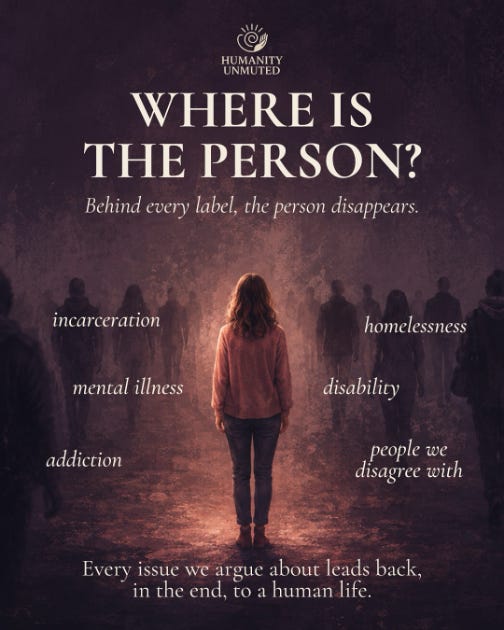
Before the label, where is the person?
Before the judgment, where is the person?
Before the assumption, where is the person?
Every issue leads back to a life.
And every life holds a humanity that no category can contain.
So maybe we should start there.
With the person.
A reflection from Humanity Unmuted
Edited by Alyssa Kruse